
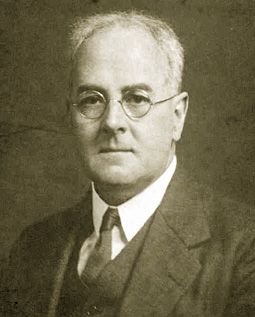
(11 October 1881 – 30 September 1953) was an English mathematician, physicist, meteorologist, psychologist and pacifist who pioneered modern mathematical techniques of weather forecasting.
Born into a prosperous Quaker family Richardson was the youngest of seven children. He began his education at Newcastle Preparatory School, and at the age of 12 was sent to York to attend the Quaker boarding school Bootham School.
It was at Bootham that Richardson developed an interest in science, encouraged by J Edmund Clark, a school master who was an expert in meteorology. His education at Bootham School reinforced his strong Quaker beliefs and especially his pacifism, which greatly influenced the way he led his life and the research topics he chose to dedicate his time to.
Richardson’s education was completed at King’s College, Cambridge in 1903, where he graduated with a first class degree in the Natural Science Tripos. Richardson went on to hold a large number of varied posts. He worked in the National Physical Laboratory, the Meteorological Office, and was a chemist with National Peat Industries. He also held academic posts at the University of Aberystwyth and Manchester College of Technology.
Born into a prosperous Quaker family Richardson was the youngest of seven children. He began his education at Newcastle Preparatory School, and at the age of 12 was sent to York to attend the Quaker boarding school Bootham School.
It was at Bootham that Richardson developed an interest in science, encouraged by J Edmund Clark, a school master who was an expert in meteorology. His education at Bootham School reinforced his strong Quaker beliefs and especially his pacifism, which greatly influenced the way he led his life and the research topics he chose to dedicate his time to.
Richardson’s education was completed at King’s College, Cambridge in 1903, where he graduated with a first class degree in the Natural Science Tripos. Richardson went on to hold a large number of varied posts. He worked in the National Physical Laboratory, the Meteorological Office, and was a chemist with National Peat Industries. He also held academic posts at the University of Aberystwyth and Manchester College of Technology.
Key Contributions to CFD & Mathematics:
- Richardson Effect/Fractals: Discovered that measuring the length of a coastline depends on the scale, pioneering fractal analysis.
- Finite Difference Method: Developed to solve complex differential equations for water flow in peat (1908) and later applied to atmospheric dynamics.
- Numerical Weather Prediction: Conducted the first manual 6-hour forecast, which was inaccurate but established the foundational methodology for modern weather forecasting.
- Richardson Iteration & Extrapolation: Developed techniques for solving systems of linear equations and improving the accuracy of numerical results.
- Richardson Number: A fundamental dimensionless number in fluid dynamics representing the ratio of buoyancy to flow shear, critical in turbulence studies.
Key Contributions and Legacy:
- Scientific Legacy: The European Geosciences Union awards the Lewis Fry Richardson Medal for exceptional contributions to nonlinear geophysics.
- Numerical Weather Prediction: Richardson pioneered the use of finite differences to solve differential equations for forecasting weather, proposing a, by-hand “forecast factory” that predated modern computing.
- Richardson Number (): He defined a dimensionless number in fluid dynamics that expresses the ratio of buoyancy to flow shear, critical for understanding turbulence.
- Conflict Studies: Applying mathematical techniques to social science, he modeled arms races and analyzed the statistics of wars in The Statistics of Deadly Quarrels.
- Fractals & Coastline Paradox: His work on measuring coastlines led to the, discovery that measured length increases with the scale of the ruler, a foundation for fractal geometry.