CFDFlow

Computational fluid dynamics News

t8code – the open-source library for extremely efficient simulations with adaptive grids

tn8
tn8

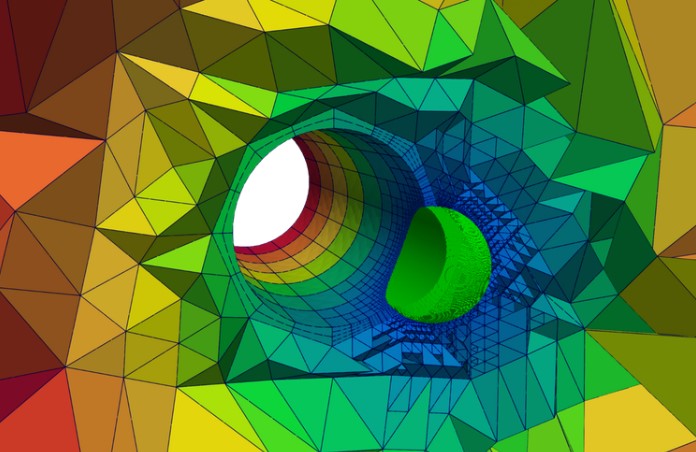
t8code is a software library for efficient management of dynamic adaptive grids and data on them.Any simulation software that uses grids can benefit from t8code as a plugin, because it supports and enhances various simulation applications. t8code is very general-purpose because it supports just about any grid needed by numerical simulation software.
t8code is a C/C++ library to manage parallel adaptive meshes with various element types. t8code uses a collection (a forest) of multiple connected adaptive space-trees in parallel and scales to at least one million MPI ranks and over 1 Trillion mesh elements.

(more…)

Finite Element and Finite Volume Methods for Heat Transfer and Fluid Dynamics

By J. N. Reddy; N. K. Anand; P. Roy , Introduces the two most common numerical methods for heat transfer and fluid dynamics equations, using clear and accessible language. This unique approach covers all necessary mathematical preliminaries at the beginning of the book for the reader to sail smoothly through the chapters. Students will work step-by-step through the most common benchmark heat transfer and fluid dynamics problems, firmly grounding themselves in how the governing equations are discretized, how boundary conditions are imposed

(more…)

Lewis Fry Richardson

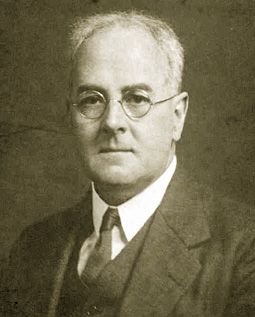
(11 October 1881 – 30 September 1953) was an English mathematician, physicist, meteorologist, psychologist and pacifist who pioneered modern mathematical techniques of weather forecasting.
Born into a prosperous Quaker family Richardson was the youngest of seven children. He began his education at Newcastle Preparatory School, and at the age of 12 was sent to York to attend the Quaker boarding school Bootham School.

(more…)

Finite Difference Method

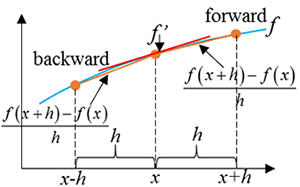
The Finite Difference Method (FDM) is an Eulerian method that involves approximating the derivative of a function using finite differences. It relies on a previously defined spatial discrete mesh of nodes. The starting point is the Newton-Raphson method, where the derivative of the function at a point equals the slope of the tangent line to the function (curve) at that point.

(more…)

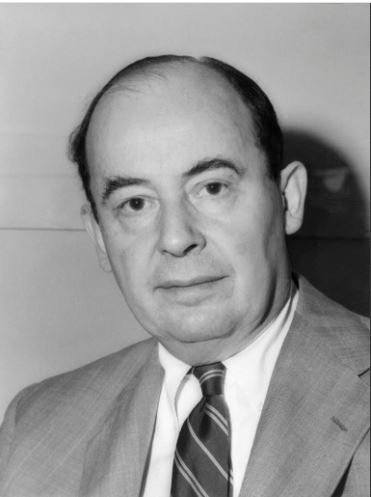
John Von Neumann

(1903-1957) was a Hungarian-American mathematician, physicist, computer scientist, and polymath who made pioneering contributions to a wide range of fields, including mathematics, physics, economics, and computer science. In the context of Computational Fluid Dynamics (CFD), von Neumann made significant contributions to the development of numerical methods for solving complex fluid flow problems.

(more…)

OpenFOAM | Open Source Computational Fluid Dynamics

OpenFOAM has gained considerable credibility in recent years through verification and validation studies performed by a growing user base. An increasing number of universities and corporations are also using OF, both independently and in conjunction with other commercial codes. Skimming the agendas of previous OF User Conferences one sees that companies such as Mercedes Benz, BASF, BMW, Volkswagen, and Intel are among those with a presence. This is not surprising, as it is such large companies with inherently large simulation workloads that stand to benefit the most from freeware.

(more…)

Code Saturne

code_saturne is the free, open-source software developed primarily by EDF for computational fluid dynamics (CFD) applications.

It solves the Navier-Stokes equations with scalar transport for 2D, 2D-axisymmetric, and 3D flows, whether steady or unsteady, laminar or turbulent, incompressible, dilatable, or weakly compressible, isothermal or not.

(more…)
CFDFlow © 2015 Frontier Theme